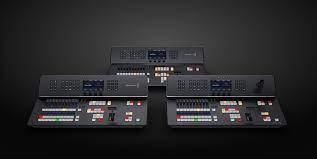
The Blackmagic Design Spares - ATEM 2 M/E Panel - Display refers to the primary liquid crystal display (LCD) assembly found in the system control section of the 2 M/E Advanced or Broadcast Panels.
In these large-format panels, the display is the visual "cockpit." It provides real-time feedback for menu navigation, keyer settings, and system configuration. Because it is a high-duty cycle part that remains powered on for the duration of a broadcast, it is prone to environmental and electrical wear.
Core Responsibilities
-
Menu GUI: Renders the graphical interface for the ATEM's internal settings, including Chroma Keyers, DVE parameters, and Transition styles.
-
Soft-Knob Feedback: Displays the dynamic values (numbers and bars) that change as you rotate the physical encoders located directly beneath the screen.
-
Status Monitoring: Shows the current IP address, firmware version, and communication status with the ATEM switcher.
-
Tally and Labeling: On some newer Advanced Panel models, the displays above the faders or cross-points serve to label inputs (often called "Scribble Strips").
When to Replace the Display
-
The "White Screen": The display receives power (the backlight is on), but it shows no text or graphics, often indicating a failure of the internal display controller.
-
Dead Pixels or Lines: Permanent vertical or horizontal lines across the screen, usually caused by a failure in the ribbon cable's "TAB" (Tape Automated Bonding) connection to the glass.
-
Dimming/Flickering: The backlight is failing or the CCFL/LED driver is inconsistent, making the screen difficult to read in bright studio environments.
-
Burn-in: "Ghost images" of previous menus remain permanently visible on the screen, common in panels that are left on the same menu page for months at a time.
-
Physical Cracks: Impact damage from a fallen microphone or equipment rack handle.
Technical Installation Note
Repair Level: 3 (Moderate). 1. Chassis "Splitting": To access the display, you typically have to remove the bottom plate of the 2 M/E panel and potentially unbolt the internal logic tray.
2. Ribbon Cable Sensitivity: The display connects to the LCD PCB via a very fine-pitch Flexible Flat Cable (FFC). These are brittle; you must use a plastic spudger to pop the locking gate before pulling the cable.
3. Dust Prevention: When swapping the display, ensure the area between the new LCD and the clear plastic protective "window" of the panel is completely free of dust. Once reassembled, any trapped lint will be highlighted by the screen's backlight.
4. Static Protection: Always use an ESD-safe wrist strap. The glass of the display can carry a static charge that can zap the sensitive driver chips on the back of the module.
Diagnostic: Display vs. LCD PCB
Before ordering just the display, determine if the "brain" (the PCB) or the "eyes" (the glass) is broken:
-
It is the Display if: You see physical cracks, "bleeding" ink-like spots, or specific dead lines while the rest of the image is clear.
-
It is the LCD PCB if: The screen is perfectly lit but completely blank, or if the text is replaced by "gibberish" characters/static.
Pro-Tip: Brightness Management
To extend the life of a new display, use the Panel Settings (accessible via the ATEM Setup Utility) to lower the button and screen brightness to 70–80%. Running the display at 100% brightness 24/7 significantly accelerates backlight decay and "burn-in" issues.
Is your screen physically cracked, or has it simply gone dark or white while the rest of the panel is still functioning?