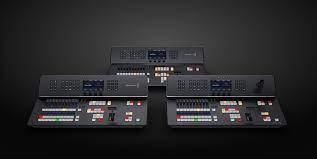
The Blackmagic Design Spares - ATEM Panel - T-Bar is the iconic manual transition controller found on all ATEM Broadcast and Advanced Panels. While it looks like a simple mechanical lever, it is a precision optical or Hall-effect sensor assembly designed to provide smooth, frame-accurate control over dissolves, wipes, and DVE moves.
Core Components
-
The Handle & Arm: The physical chrome or matte lever the operator grips. It is weighted to provide a specific "resistance" or "drag" preferred by professional TDs (Technical Directors).
-
The Sensor Assembly: Most modern ATEM panels use non-contact Optical Encoders or Hall-effect (magnetic) sensors. This ensures that there are no physical "wiper" contacts to wear out or get "scratchy" like a traditional audio fader.
-
The Dust Shield: A sliding plastic or felt barrier that moves with the arm to prevent dust, hair, and debris from falling into the internal electronics of the transition module.
-
End-Stop Dampers: Small rubber or silicone bumpers at the top and bottom of the travel to prevent a metallic "clack" when finishing a transition.
When to Replace the T-Bar
-
Transition "Jumping": You move the handle smoothly, but the video on screen stutters, flickers, or suddenly "snaps" to the end of the transition. This indicates a failing sensor or a dirty optical disc.
-
Mechanical "Grittiness": The handle feels like it is grinding against sand or has "flat spots" in its rotation. This usually means the internal bearings have failed or debris has bypassed the dust shield.
-
Calibration Drift: Even after running the panel's calibration routine, the T-Bar refuses to reach "0%" or "100%" (meaning you can never fully complete a manual transition).
-
Physical Play: The arm has significant side-to-side "wobble," indicating that the mounting housing or the main pivot shaft has loosened or worn down.
Technical Installation & Calibration
Repair Level: 3 (Moderate).
-
Chassis Integration: The T-Bar is usually bolted to the ME1 or ME2 Transition Module. In many cases, you must remove the entire module from the panel before you can unscrew the T-Bar assembly itself.
-
Cable Header: It connects via a small 3-pin or 4-pin harness to the transition PCB. Ensure this cable is routed away from the moving arm so it doesn't get pinched or frayed over time.
-
The "Dust Gap": When installing, ensure the sliding dust shield is centered. If it's misaligned, it will create friction against the faceplate, making the fader feel heavy or sticky.
-
Critical: Software Calibration: Once the hardware is installed, you must calibrate it.
-
On Advanced Panels: Navigate to Settings > Maintenance > Fader Cal.
-
Follow the on-screen prompts to move the handle to the top, then the bottom, to map the digital limits.
Diagnostic: T-Bar vs. Module Logic
-
It is the T-Bar if: Manual transitions glitch, but the AUTO button (software-driven transition) works perfectly.
-
It is the Transition Module if: Both the manual T-Bar and the AUTO button fail to trigger a transition, or if the frame-rate display is also dead.
Pro-Tip: If your T-Bar feels "loose" but the signal is fine, you don't always need a new spare. Most ATEM T-Bars have a tension adjustment screw located internally. Tightening this screw increases the "drag" of the handle, restoring that "heavy" professional feel.
Are you experiencing digital "stuttering" during your transitions, or has the handle become physically loose or damaged?