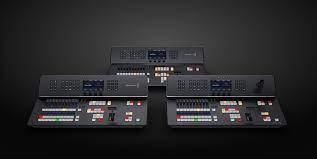
The Blackmagic Design Spares - ATEM Television Studio HD - Button refers to the tactile switching components located on the front panel of the 1RU rack-mount unit. On this specific model, the buttons are smaller and more "clicky" than the larger broadcast buttons found on the "Pro" or "Advanced" panels.
Depending on your issue, the "button" usually involves one of three distinct parts:
1. The Clear Keycap (User Interface)
This is the transparent plastic cover that snaps onto the button stem.
-
Purpose: Protects the label and diffuses the internal Red/Green LED light.
-
Common Issue: Becomes yellowed over time, cracks at the retention clips, or gets lost during cleaning.
-
Repair Level: 1 (Very Easy). Snaps on/off from the front without opening the unit.
2. The Button Stem / Plunger
The internal plastic piece that connects the keycap to the electronic switch.
-
Purpose: Ensures the vertical travel of the button is smooth and centered.
-
Common Issue: Sticking due to liquid spills (soda/coffee) or dust buildup in the "collar" where the stem meets the metal faceplate.
-
Repair Level: 2 (Moderate). Requires removing the front faceplate to clean properly.
3. The Tactile Switch (The Electronic Part)
The actual electronic component soldered to the Front PCB.
-
Type: A 4-pin or 2-pin surface-mount (SMD) tactile switch, often featuring an integrated or adjacent dual-color LED.
-
Failure Symptom: You feel a "click," but the switcher doesn't register the command. Or, the button "double-taps" (e.g., you press CAM 1 and it instantly jumps back to the previous source).
-
Repair Level: 4 (Advanced). Requires opening the unit, removing the Front PCB, and precision desoldering/soldering.
Troubleshooting a Failing Button
| Symptom |
Probable Cause |
Fix |
| Button feels "mushy" or stays down |
Physical debris or "sticky" residue |
Clean around the stem with 99% Isopropyl Alcohol. |
| Button clicks but doesn't work |
Oxidation on internal switch contacts |
Apply a tiny drop of DeoxIT Fader F-Series; if that fails, replace the switch. |
| Button works but has no light |
Failed LED on the Front PCB |
Requires replacing the specific SMD LED or the entire Front PCB. |
| Button is physically missing |
Snapped stem or lost cap |
Order the "Keycap and Stem" spare kit. |
Technical Installation Tip
If you are replacing the electronic switch itself:
-
Chassis Opening: You must remove the top cover and the front aluminum plate.
-
Ribbon Cable: Be extremely careful with the wide ribbon cable connecting the Front PCB to the Main PCB. If you tear this, the entire front panel (including the LCD) will die.
-
Heat Control: When soldering new tactile switches, use a temperature-controlled iron. Excess heat can melt the plastic housing of the new switch, ruining it before you even use it.
Pro-Tip: The "Exercise" Method
If a button is intermittently failing to register, it may simply have "surface oxidation." With the unit powered off, press the problematic button rapidly 50–100 times. This mechanical friction can sometimes "wipe" the internal contacts clean without needing to open the chassis or buy a spare.
Are you dealing with a button that is physically stuck/broken, or one that clicks but just isn't responding in the software?