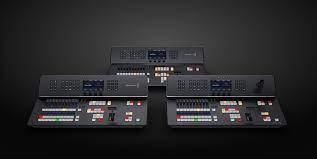
The Blackmagic Design Spares - ATEM Television Studio HD - Mezzanine PCB is the secondary internal board found in the compact 1RU rack-mount version of the ATEM Television Studio HD.
In this specific model, the Mezzanine (or "Mezz") board is essentially the I/O Expansion Module. While the Main PCB handles the system's "brain" functions (network, software communication, and master logic), the Mezzanine board is where the heavy lifting of video signal processing for the inputs and outputs occurs.
Core Responsibilities
-
SDI/HDMI Processing: This board houses the chips responsible for the 4 SDI and 4 HDMI inputs. It handles the initial signal equalization and re-syncing.
-
Format Conversion: On the "HD" model, this board manages the frame synchronizers that allow you to mix different frame rates (as long as they are the same resolution) without a glitch.
-
BNC/HDMI Interface: It provides the physical electrical connection between the rear connectors and the central FPGA on the Main PCB.
-
Signal "Sandwich": It bridges the data from the physical ports to the main processor via high-density, multi-pin "board-to-board" connectors.
When to Replace the Mezzanine PCB
Because this board is directly connected to the external world via BNC and HDMI, it is the most likely component to be damaged by electrical issues.
-
Input Bank Failure: If all HDMI inputs work but all SDI inputs are "black" (or vice versa), the specific controller chip on the Mezzanine board has likely failed.
-
"Sparking" or Hot-Plugging Damage: If you plugged in a camera with a different ground potential and saw a small spark, the ESD protection diodes on the Mezzanine board usually take the hit to protect the Main PCB.
-
HDMI Port Physical Failure: Since HDMI ports are surface-mounted, enough "wiggling" of cables can rip the pads off the PCB. Swapping the Mezzanine board is the standard professional fix for broken physical ports.
-
Video "Noise": If you see digital snow, sparkles, or "tearing" on all video inputs, but your Media Pool graphics look perfect, the Mezzanine board is failing to pass clean data to the Main PCB.
Technical Installation Note
Repair Level: 4 (Advanced). 1. The Interconnect: The Mezzanine board is joined to the Main PCB by high-density pins. Crucial: You must pull the board straight up. If you tilt it while pulling, you will bend the pins on the Main PCB, which is a catastrophic failure.
-
Back-Panel Alignment: Every BNC nut and HDMI screw on the back of the unit must be removed before the board can be released. When re-installing, do not tighten any single nut until all of them are threaded, or the board will be under physical stress.
-
Thermal Pads: This board often has a thermal pad on the underside that dissipates heat into the Main PCB’s heatsink or the metal chassis. Always replace this pad; an air gap will cause the inputs to fail again due to overheating.
-
Static Control: This is a high-speed CMOS board. Touch a grounded metal object or wear an ESD strap before handling.
Diagnostic: Mezzanine vs. Main
-
It is the Mezzanine Board if: The unit powers on, connects to the computer, and displays the Multiview UI, but all (or a specific set) of your external camera inputs show as black.
-
It is the Main Board if: The unit won't boot, won't show the Multiview UI at all, or won't communicate over Ethernet/USB.
Expert Advice: If you are losing inputs frequently, check your power source. These boards are sensitive to "dirty power." Using a high-quality UPS (Uninterruptible Power Supply) for your switcher and your cameras can prevent the voltage spikes that kill the Mezzanine board.
Are you losing a specific set of inputs (like just the HDMI ports), or is the entire input bank unresponsive?